When we started free.studio, we didn't write a manifesto. We didn't commission a values workshop. Nobody stood in front of a whiteboard and wrote the word culture in block capitals while everyone nodded solemnly and thought about lunch.
We just asked a question: what if the best people in the industry could work together on the best projects without the structural baggage of traditional agencies?
That was it. That was the whole thing. And from that question, two decisions followed that have ended up shaping everything — the membership model, and the charter. They're not complicated. They're not even particularly long. But they might be the most important things we've built.
The month-to-month bit, and why it matters more than it sounds.
Our membership is month-to-month. No lock-in contracts. No minimum terms. $350 a month in Melbourne. £350 in London — less if you're a founding member, because we like rewarding people who back things early.
That's the structure. It's not an accident, and it's not a commercial compromise. It's the point.
Because here's what a month-to-month membership actually says, when you strip away the logistics: we trust you, and we'd like you to trust us, and neither of us should have to sign a document that forces us to pretend that's the case.
Lock-in contracts exist because someone, somewhere, doesn't trust the relationship to hold on its own merits. They're a hedge against disappointment. A pre-emptive defence against the possibility that one party might wake up and realise they'd rather be somewhere else. Which — if you think about it for more than three seconds — is a spectacularly grim foundation for a creative community.
We wanted the opposite. We wanted a model where people stay because they want to, not because they're contractually obliged to. Where every month is, in effect, a quiet re-commitment. I'm still here. This still works. Let's keep going.
It turns out that when you build it that way, people stay. Not because they have to. Because the thing actually works. Because they've found their people, and the work is good, and the coffee's decent, and nobody's asking them to fill in a timesheet or justify their existence to a utilisation spreadsheet.
The frictionlessness is the feature. Remove the friction, and what's left is the relationship. And if the relationship isn't enough on its own — well, then a contract wasn't going to save it anyway.
The charter. Or: the shortest, most important document we've ever written.
Early on, we needed to answer a question that every studio, agency, co-working space and creative collective eventually has to face: how do you make sure the people in the room are good to be around?
The industry has tried a lot of things. "No dickheads" policies. "Leave your ego at the door" posters. Offsite workshops where everyone does trust falls and promises to be more empathetic, then goes back to being exactly the same by Wednesday.
We didn't want a slogan. We wanted something that actually described the kind of person we were looking for — and, more importantly, gave people permission to be that person without feeling like they were performing it.
So we wrote a charter. One page. No jargon. No corporate tone. Just an honest description of what a free-folk is.
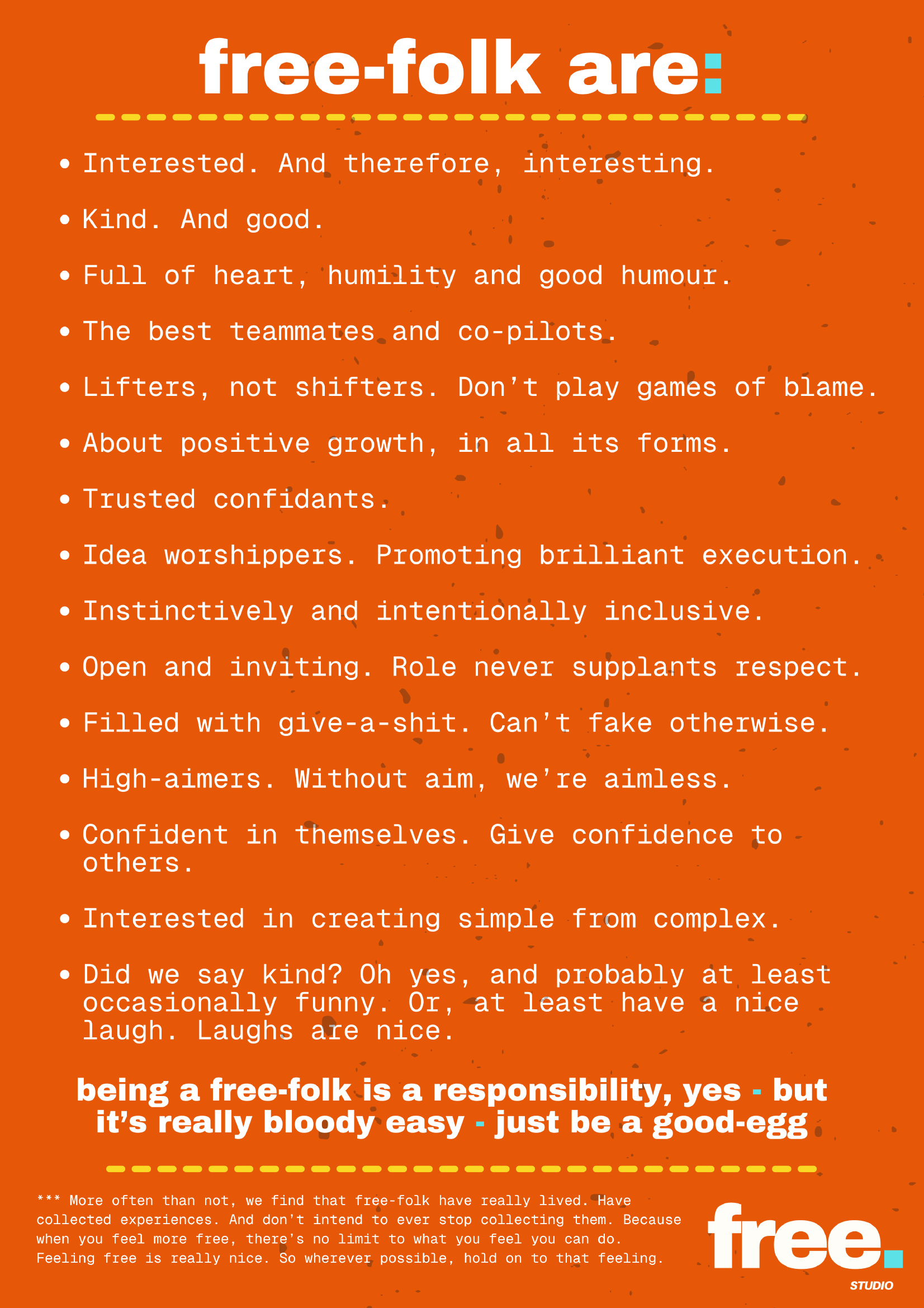
Read it again. There's no mention of KPIs. No reference to "high performance" or "results-driven mindsets." No language borrowed from HR playbooks or management consultancies.
Instead: Interested. And therefore, interesting. That's the opening line. Not "passionate and proactive" or "dynamic self-starters." Just — be curious. Be the kind of person who notices things. And by extension, be the kind of person other people enjoy being around.
Kind. And good. Two words that appear in almost no agency charter anywhere in the world, because somewhere along the line, the industry decided that kindness was soft and softness was weakness. We think that's nonsense. Kindness isn't soft. It's the hardest, most deliberate choice you can make in a room full of deadlines and egos and competing ideas. It takes more strength to be generous than to be sharp. Anyone can be sharp. Sharp's easy. Kind is a decision you make, over and over, especially when it's inconvenient.
Lifters, not shifters. This one does a lot of quiet work. In every team, in every project, in every room — there are people who lift the energy, the standard, the mood. And there are people who shift the blame, the responsibility, the credit. You know the difference instantly. You can feel it. We just wrote it down so nobody had to guess which one we were looking for.
Filled with give-a-shit. Can't fake otherwise. There it is. The line that says everything a 40-page culture deck tries to say and fails. Either you care or you don't. And if you don't, that's fine — but this probably isn't your place. No hard feelings. Genuinely. Some environments suit some people. This one suits people who give a shit. We don't apologise for that, and we don't try to manufacture it.
Did we say kind? Oh yes, and probably at least occasionally funny. Or, at least have a nice laugh. Laughs are nice. We put that in because we meant it, and because every document gets better when it makes you smile at least once. Work is long. Days are full. If you can't laugh with the people next to you, something's wrong, and no amount of ping pong tables and free kombucha will fix it.
Why this works. (And why we know it works.)
Melbourne has been running since 2024. And the thing we've noticed — the thing that genuinely surprised us, even though it shouldn't have — is that the charter does something a "no dickheads" policy never could.
A "no dickheads" policy is reactive. It draws a line and dares people to cross it. It's a negative constraint — it tells you what not to be, which is useful, but limited. It doesn't give anyone a picture of what to be. It doesn't describe the warmth. The curiosity. The generosity. The give-a-shit. It just says don't be terrible and hopes for the best.
The charter is affirmative. It paints a picture. It says: this is who we are, this is who we'd love you to be, and if this sounds like you — genuinely, not aspirationally, not on your best day only — then come in. The door's open. There's coffee. Someone's probably telling a mildly inappropriate joke about a client brief. You'll fit right in.
What that creates — slowly, and then all at once — is a self-selecting community. People read the charter and either recognise themselves in it or they don't. The ones who do, walk in. The ones who don't, don't. And that's fine. That's the system working as intended. No awkward performance reviews. No cultural alignment workshops. No three-month probation periods where everyone politely pretends to be their best self before gradually reverting to type.
Just: here's who we are. Are you one of us? Brilliant. Grab a desk.
Taking it to London. (Where the creative community already knows what this feels like.)
This May, free.studio London opens. New city, same question: what happens when you give brilliant people the structure to do their best work, and then get out of the way?
London's creative community is — and we say this having spent a lot of time in it — a brilliant, beautiful, binding thing. It holds its people close. The city is expensive, demanding, relentless, and frequently damp. And yet the people who make things there keep choosing to make things there, because there's something in the water (besides Thames). A density of talent. A shared understanding that the work matters. A collective stubbornness about standards that we find deeply attractive.
We're not arriving in London to teach anyone anything. That would be absurd. London doesn't need an Australian studio to explain creativity to it. What we're offering is a structure. A model. A way of working that strips out the bits that make the industry exhausting — the politics, the timesheets, the utilisation targets, the structural ego, the overhead, the meetings-about-meetings — and replaces them with space. Actual space. Physical space to work, and structural space to breathe.
The membership is the same: month-to-month. The charter is the same: be a good egg. The principle is the same: if you're good, and you care, and you want to work alongside other people who are good and who care, then this is for you. We're not interested in building the next big agency. We're interested in building the best small room.
The founding membership is open now. £250 for the first month, then £350 ongoing, with the rate locked for twelve months for anyone who gets in early. Founding members get input into how the London studio takes shape — because we believe the people in the room should build the room. Not the other way around.
The bit about feelings. (Because why not.)
There's a line at the end of the charter that we come back to more than any other:
More often than not, we find that free-folk have really lived. Have collected experiences. And don't intend to ever stop collecting them. Because when you feel more free, there's no limit to what you feel you can do. Feeling free is really nice. So wherever possible, hold on to that feeling.
That's not a business proposition. It's not a value statement that'll survive a due diligence process. It's just — true. And it's the reason behind everything else.
The month-to-month membership exists because freedom feels better than obligation. The charter exists because description works better than prohibition. The flat structure exists because hierarchy is useful for armies but terrible for ideas. The casting model exists because the best team for a brief should be chosen for that brief, not inherited from an org chart.
None of this is revolutionary. It's not disruptive. It's not even particularly clever. It's just — considerate. Which, in an industry that has spent decades optimising for everything except the experience of the people inside it, turns out to be a fairly radical act.
We built free.studio for the people in it. Not for a holding company. Not for a pitch deck. Not for a valuation. For the people. The free-folk. The good eggs.
And it turns out, when you build something for good eggs, good eggs show up.